Life insurance distribution remains market-specific, with independent intermediaries gaining share in the US while bancassurance dominates France and Italy.
Life insurance distribution continues to vary substantially across global markets, influenced by differences in retirement systems, product design, regulation and consumer preferences.
Insurance intermediaries remain the leading distribution channel in most markets, although bancassurance continues to dominate in several European and Asian countries.
Key highlights
- Insurance intermediaries distribute more than 70% of new life insurance business in Germany, while banks account for approximately two-thirds of life premiums in France.
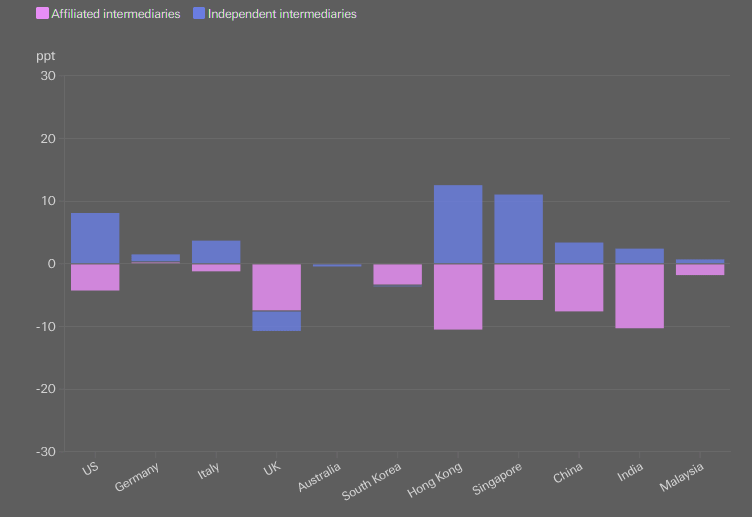
- Independent intermediaries have increased their share of US individual life insurance distribution by more than eight percentage points since 2019, reaching around 60%.
- Changes in pension provision, intermediary consolidation and higher professional requirements are supporting independent distribution, although market structures continue to differ.
The distribution model is particularly important in life insurance because products involve long-term financial commitments and often require professional advice. Insurers develop products, provide risk capital and manage liabilities, but agents, brokers, financial advisers and banks frequently control access to customers (see TOP 100 Life & Health Insurers in the U.S.).
Insurance intermediaries account for more than half of life insurance premiums in most markets analysed by Swiss Re Institute, highlighting the importance of advice-based distribution.
Competition between insurers therefore depends partly on their ability to secure access to effective distribution networks, rather than product characteristics alone. The US individual life insurance market delivered another growth quarter in Q2 2026, as total new annualized with excess premium reached $4.7 bn.
Life insurance distribution models differ across global markets

Intermediaries remain the principal distribution channel in most markets examined by Swiss Re Institute (SRI). Their role is especially significant for products that require personalised financial advice, including life protection, retirement income and wealth planning.
In Germany, agents, brokers and other insurance intermediaries distribute more than 70% of new life insurance business.
Intermediary-led distribution is particularly important where consumers need assistance comparing long-term protection and retirement products.
Bancassurance has a stronger position in markets where banks maintain established customer relationships and life insurance is closely integrated with savings and investment products.
Banks distribute approximately two-thirds of life insurance premiums in France. Bancassurance also dominates in Italy and remains an important channel in several Asian markets. U.S. life insurers posted modest Prism score gains, with resilient capital strength despite rising annuity volumes and investment risk pressures.
Life insurance distribution channel mix, by country, %
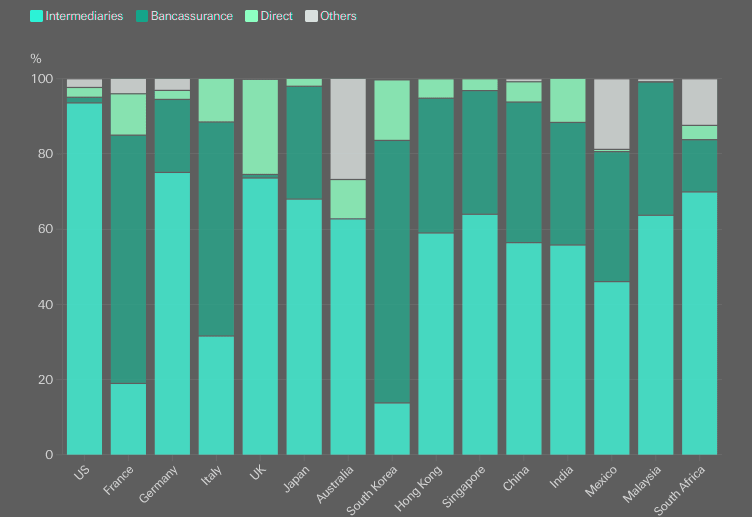
Direct distribution accounts for a smaller share of life insurance premiums globally. It is generally more suitable for straightforward protection products that require limited financial guidance.
France and Germany illustrate contrasting distribution structures: banks account for roughly two-thirds of French life premiums, while intermediaries handle more than 70% of new German life business.
These differences demonstrate why life insurers cannot rely on a single distribution strategy across international markets.
Independent insurance intermediaries increase market share
Independent financial advisers, brokers and other intermediaries offering products from multiple insurers have expanded their market share in several major insurance markets.
Since 2019, independent distribution has generally gained ground, while affiliated agents and other tied intermediaries have maintained or lost share. The US provides one of the clearest examples.
Independent intermediaries now distribute approximately 60% of US individual life insurance business, an increase of more than eight percentage points since 2019.
Unlike affiliated agents, who typically represent a particular insurer, independent intermediaries can compare products across multiple providers.
This structure allows advisers to address different protection, retirement and wealth management needs without being restricted to one insurer’s product portfolio.
Changes in channel distribution, affiliated vs. independent intermediaries
The shift also changes how life insurers compete for business. Access to independent advisers increasingly depends on the attractiveness of their products and the support they provide to distribution partners.
The expansion of independent distribution gives multi-provider advisers a larger role in determining which insurers and products reach customers.
Nevertheless, independent channels have not gained share consistently across all countries. Affiliated agency networks and bancassurance remain established distribution models where existing relationships and market conditions support them.
Pension reforms and consolidation support independent distribution
Changes in retirement provision are contributing to the increased importance of independent financial advice.
As more individuals participate in pension arrangements that allow them to manage retirement savings and investment decisions, demand for advice on protection, retirement income and wealth accumulation is increasing.
Independent intermediaries are positioned to address these requirements because they combine individual financial guidance with access to products from competing insurers.
The shift towards pension systems that give individuals greater responsibility for retirement decisions is increasing demand for financial advice.
Changes within the intermediary sector are also influencing distribution.
Consolidation and higher professional standards are producing fewer but larger intermediary organisations. These businesses generally have greater resources to invest in regulatory compliance, technology and adviser support.
Larger independent distribution firms can provide specialised services while maintaining relationships with multiple insurance companies.
Consolidation is creating larger intermediary businesses with greater capacity to invest in compliance, technology and support for financial advisers.
These developments are strengthening independent distribution in markets where customers seek broader product choice and professional advice.
Bancassurance and affiliated agencies retain strong market positions
The increasing share of independent intermediaries does not mean that bancassurance or affiliated agencies are declining everywhere.
Banks retain advantages in markets where customers regularly purchase insurance alongside savings, investment and other financial products.
Established banking relationships can provide insurers with access to existing customer networks, particularly where life insurance forms part of broader wealth management arrangements.
Affiliated agencies also remain important where insurers have established distribution networks and customers prefer longstanding relationships with individual agents.
The balance between independent advisers, affiliated agents, banks and direct insurers remains closely linked to national retirement systems, regulation and customer preferences.
Direct distribution continues to serve a more limited segment of the life insurance market, primarily involving products that can be purchased without extensive advice.
The distribution structure of each market therefore remains an important consideration for insurers seeking to expand sales or develop new products.
Although independent intermediaries are gaining market share in several countries, bancassurance and affiliated agency models remain competitive where local market conditions favour them.
Life insurance distribution is consequently developing along different paths across countries, with retirement arrangements, intermediary structures and established customer relationships determining the relative importance of each channel.